
After fourteen years of brutal civil war, the al-Assad regime and its opponents saw their conflict abruptly end on 8 December 2024. Syrians immediately poured into the streets to celebrate, expressing their relief on social media that the decades-long legacy of the family had concluded. Christians were happy too but also in fear. What does the new Syria look like for them?
Assad’s legacy was characterised by widespread repression and atrocities committed against civilians, leading to a profound humanitarian crisis and a partly destroyed country after all those years of war.
The new authority, Hayaat Tahrir al-Sham (HTS), declared the establishment of a transitional government. In January, the appointment of its leader, Ahmed al-Sharaa, as interim president formalised the new political landscape.
One year after the regime’s fall, the Syrian landscape has been dramatically reshaped. On one hand, there are positive changes: electricity service has improved across the country, markets are open, citizens have new opportunities to start work, and there is an increase in the freedom to express opinions without the fear of being hunted. Syria has begun to re-engage with the international community.
Yet, this hopeful picture is deeply shadowed. Since the beginning of the year, the country has been gripped by a cash crisis. Banks remain unable to give citizens access to their own money or salaries, limiting withdrawals to a barely sustainable $20 per week. Many people who worked for the government or in the army are now jobless, dragging families into poverty. There is also a lack of security; people take revenge, and criminals rob and kill people—stemming from a lack of security forces and consistently changing rules, with no clarity.
Adding to that instability, two major incidents of violence have erupted. In March 2025, a terrible single act of violence, a massacre, was reported against the Alawite people in the coastal areas, leading to the death of over 1,000 people. According to the Syrian Network of Human Rights, the Syrian Observatory for Human Rights says that over 2,100 people were killed. Among those who lost their lives were five Christians, as far as we know not because of their Christian faith.
In April and May, and later, on 2 July, further strife flared in the Druze-majority province of Suweyda in southern Syria, primarily involving clashes between Bedouin tribes, local Druze groups, and the transitional government forces. This violence led to the death of about one thousand people, including 539 Druze civilians.
Amidst this, the question remains: where does the Christian community stand?
The new authority’s Sunni Islamic background has caused deep anxiety among the Christian population. Islamic influence now controls state and government facilities. “Everywhere, a sheik appears to be making key decisions, in the government but also in the checkpoints,” several church leaders share.
In the streets, changes can be seen as the former rebels, who, before the fall of the Assad regime only had Idlib and surroundings under their control, are now spread over the country. Those often-bearded men and veiled women can be seen in the streets everywhere.
Throughout the year, daily life became more challenging for Christians because of different forms of persecution.
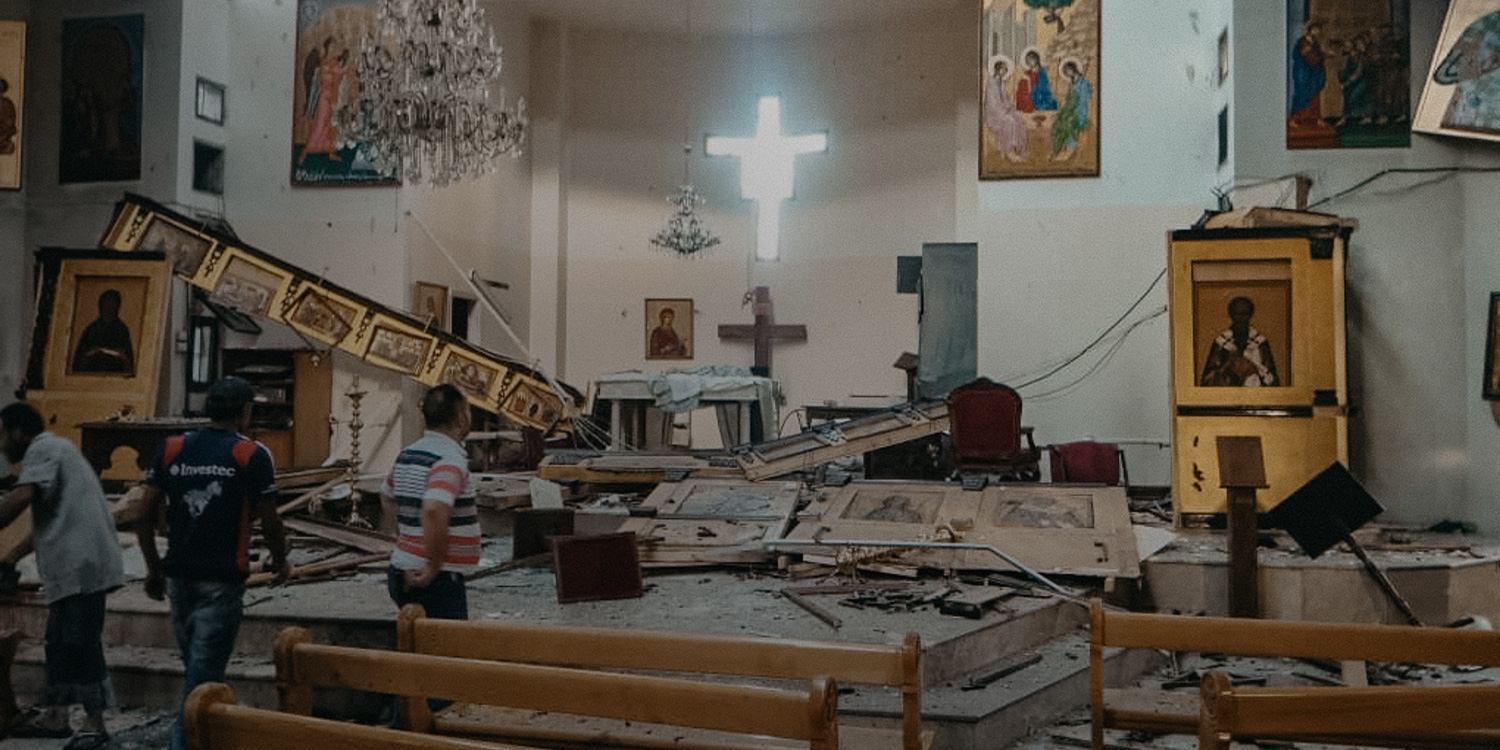
Most shocking was the bombing of St. Elias Church in Dweila, Damascus, on 22 June, where 25 people were killed; 22 of them Christians, and about 60 Christians were injured. This terror attack was a profound shock. For a week, churches all around Syria were almost empty, and all activities were postponed. “The youth felt frustrated, believing that the time for changing the minds of the people around them had tragically passed,” Bishop Tobji in Aleppo sadly says. “We invited 150 youth to attend a dialogue session about citizens and the new Syria; only four came.”
Compared to the past, children in public schools hear offensive words more often from peers. “It’s so hard that some families from our congregation refrained from sending their children to schools because of them being harmed by verbal abuse because they are Christians,” shares Father Yohana, priest of the Syriac Orthodox Church in Homs. Consequently, some families have decided to bear the burden of transportation and send their children to study in villages in the predominantly Christian countryside rather than leave them in the city. “What’s even more sad is that the church is powerless to change this reality,” he adds.
The public schools have no teachers for the Christian lessons, as Islamic students do have for their Islamic lessons. Christian children are often set apart in another class during those lectures with nothing to do. Hanan, a mother of five children in Damascus, speaks of the desperation to preserve their children’s faith and identity. “I want to send my kids to learn catechism; I want them to learn about Christianity in their school.”
Women face insults in the street, being named as “unvalued” or “infidels”. “I live in fear for my family. Throughout the year, my children saw a lot of different people with beards and guns, calling their mother an infidel. They are now scared to go to the streets or go to the church on their own,” expresses Wael. He is a worker in one of the churches in Homs.
Even the clergy face abuse. “Last week, some guys suddenly spat on me when I was in the street. They were not from the area. I just walked away with no response because it’s not the way we as Christians act,” Father Isaac from Homs recounts with sadness.
Christians who run small businesses, especially those who have shops in Muslim areas, saw a drop in the number of clients, as the non-Christians stopped buying from them. “In better times, they would support the church; now, they need the church support,” comments Wael from Homs.
Recently, threatening words were written on church walls and in Christian areas, threatening to kill Christians.
The Christians find themselves caught in the middle of a conflict that is not their own.
In the Druze-majority region around Suweyda, south of Damascus, more than half of the Christians have been internally displaced, fleeing the lack of safety. During the conflict this summer, a lot of Christians took refuge in the church, as it wasn’t safe to stay in their houses. “I don’t know how I could start again. I lost my entire life, work, house, and safety. No one can bring my life back,” Fadi, a 52-year-old from Suwayda, says. His barbershop and house were burned by an unknown group, and now he is living in a rented house in Damascus.
“After the war, we worked to restore the church, and now I see it emptying again, but we continue to perform our worship services; the church never gives up,” says the pastor of Evangelical Church in Kharaba, a village in the Suwayda province.
North Syria is still under Kurdish control. This school year, the Kurdish authorities enforced the use of the Kurdish language curriculum in all schools. This led to the closure of 14 Christian schools who used to teach in Arabic. After lengthy negotiations, the authorities finally allowed the churches to open their schools and teach the Syrian curriculum. Children were delayed by more than a month from the start of the schoolyear. “The faith among our children and their trust in the church make them be patient and hold on to the land,” says Bishop Morris, the Syriac Orthodox Bishop of Al-Jazeera.
“All people around me want to leave”
All this makes many Christians search for a safe place outside Syria. “I cannot see any positive changes because I don’t feel secure; all the people around me want to leave,” says Nariman, a worker in a church in the Christian Valley.
Despite the climate of fear, the Church is witnessing one very positive development. “A lot of Muslims, not from here, came to the church and asked about it and about what we are doing, some of them even lit a candle. We have a great opportunity to show the people who the real Christians are,” says Bishop Tobji in Aleppo.
The number of people who convert to Christianity is increasing. This includes some individuals who have returned to Syria from camps in other countries, having become Christians during their displacement. “After all the violence in the country, some non-Christians are now more open to hear about Christianity, because they see that Christianity brings peace, and we hope that God will touch their hearts,” says Razzok, pastor of the Alliance Church in Homs. This trend can be seen also among the Kurds and the Druze in Syria.
Amidst all changes and uncertainty, Christians find safety in the Church. “All this never prevented the Church from continuing its mission. Rather, it was a renewed start with greater faith and courage,” comments pastor Abdulla of the Alliance Church in Aleppo.
Father Issac in Homs says the same, “The people have become more attached to the faith, and that is a joyful thing, because no matter what they faced, their faith will not weaken.”
The future of the Christian community in post-regime Syria remains a precarious balance between deeply held faith and crippling fear of instability.
“I have faith that this darkness precedes a divine intervention, allowing the Church in Syria to not only survive but to stand steady, unmovable, and firm in its ancestral home,” says pastor Abdalla of the Alliance church in Aleppo.
Open Doors’ local partners continue to stand with the local church.
Please pray:
- Pray God gives Syrian Christians the power to face all the difficulties they have gone through.
- Ask God to touch the hearts of those who want to harm them and remove the spirit of revenge and hatred from their hearts, filling them instead with the Spirit of love.
- Pray for the work of our local partner in Syria.
Stay updated with the latest prayer requests from the persecuted church.